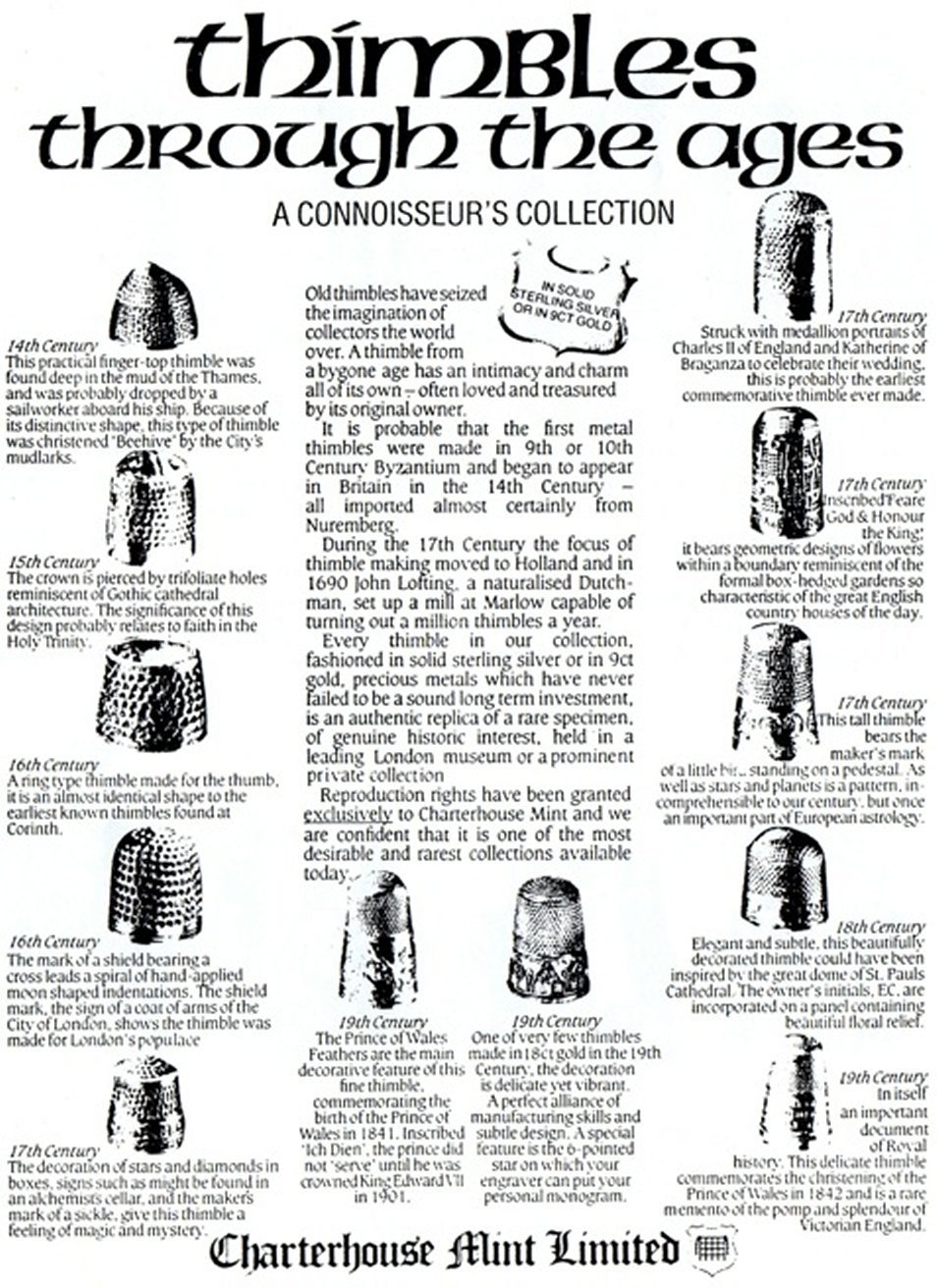
In 1986 a now defunct company called Charterhouse Mint Ltd - formerly of 64 Charlotte Street, London W1 - marketed a series of 12 historical thimbles which they called 'Thimbles through the Ages - A Connoisseur's Collection' in their advertising material. The thimbles were cast in sterling silver and 9ct gold and were copies of bronze, silver and gold thimbles held in museum and private collections. Lest there be any confusion between these reproductions and the real thing, each thimble was hallmarked at the London Assay Office in 1986. As the thimbles were never intended to be used and were only regarded as collectables the thimbles usually turn up today in undamaged condition. It should be noted however that they do of course reproduce the imperfections the originals they were copied from. Here's a typical hallmark:
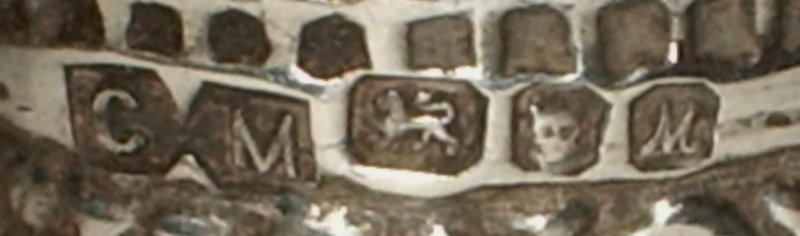
CM (for Charterhouse Mint Limited), the lion passant, the London Assay Office
leopard's head and the date letter script "M" for 1986
◊
FROM CHARTERHOUSE MINT'S ADVERTISING MATERIAL (1986):
"Old thimbles have seized the imagination of collectors the world over. A thimble from a bygone age has an intimacy and charm all of its own - often loved and treasured by its original owner.
It is probable that the first metal thimbles were made in 9th or 10th Century Byzantium and began to appear in Britain in the 14th Century - all imported almost certainly from Nuremberg.
During the 17th Century the focus of thimble making moved to Holland and in 1690 John Lofting, a naturalised Dutchman, set up a mill at Marlow capable of turning out a million thimbles a year.
Every thimble in our collection, fashioned in solid sterling silver or in 9ct cold, precious metals which have never failed to be a sound long term investment, is an authentic replica of a rare specimen, of genuine historic interest, held in a leading London museum or a prominent private collection.
Reproduction rights have been granted exclusively to Charterhouse Mint and we are confident that it is one of the most desirable and rarest collections available today."
Here is a copy of Charterhouse Mint's advertising material from 1986. Click thumbnail to see a larger image (opens in new window):

Medieval Skep or Beehive Thimble
Small medieval skep or beehive type thimble. The original would have been bronze. About this thimble Charterhouse Mint wrote: ""14th Century: This practical finger-top thimble was found deep in the mud of the Thames, and was probably dropped by a sailworker aboard his ship. Because of its distinctive shape this type of thimble was chnistened 'Beehive' by the City's mudlarks.
◊
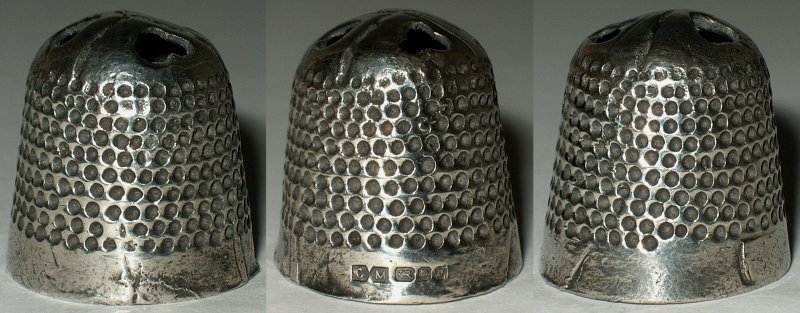
Silver Copy of Tudor Bronze Original, Crown Pierced with Three Trefoils
This is a Tudor design which has a crown pierced with three trefoils and is a copy of a bronze original. About this thimble Charterhouse Mint wrote: "15th Century: The crown is pierced by trifoliate holes reminiscent of Gothic cathedral architecture. The significance of this design probably relates to faith in the Holy Trinity.
◊
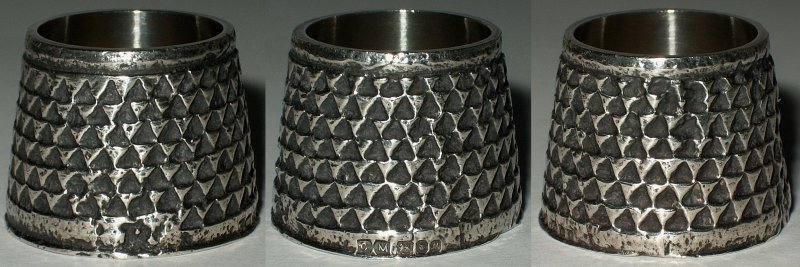
Silver Copy of a 16th Century Bronze Open Top Thimble
Large silver open top thimble or thimble ring with a maker's mark and an upward spiral of triangular indentations - a copy of a medieval design. About this thimble Charterhouse Mint wrote: "16th Century: A ring type thimble made for the thumb, it is an almost identical shape to the earliest known thimbles found at Corinth.
◊
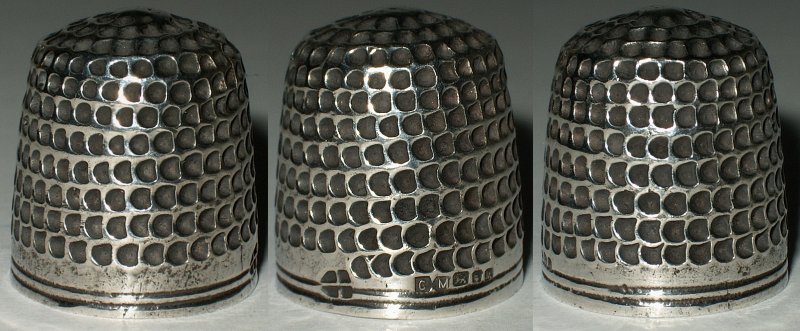
Silver Copy of 16th Century Bronze Original with Shield Mark
About this thimble Charterhouse Mint wrote: "16th Century: The mark of a shield bearing a cross leads a spiral of hand applied moon shaped indentations. The shield mark, the sign of a coat of arms of the City of London, shows the thimble was made for London's populace."
◊

Silver Copy of 17th Century Bronze Nuremberg Thimble
Copy of a bronze Nuremberg Type I thimble. It has two bands of stars and diamond shapes. About this thimble Charterhouse Mint wrote: "17th Century: The decoration of stars and diamonds in boxes, signs such as might be found in an alchemist's cellar, and the maker's mark of a sickle, give this thimble a feeling of magic and mystery.
◊
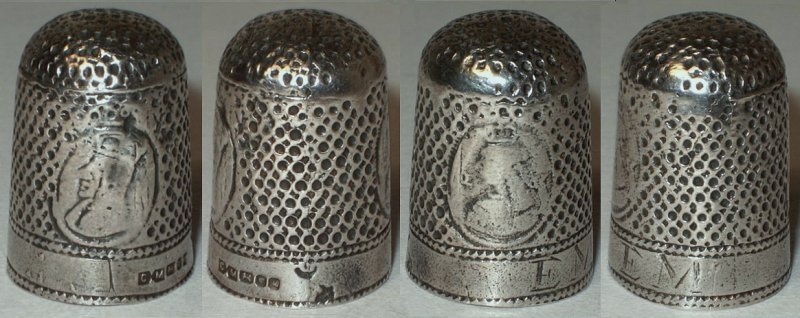
Thimble Commemorating the Marriage of King Charles II to Catherine of Braganza in May 1662.
This design is an authentic copy of an original 17th century thimble made to commemorate the marriage of King Charles II to Catherine of Braganza in May 1662. The thimble has the portraits of King Charles and his Queen Consort and the initials EM in the border. About this thimble Charterhouse Mint wrote: "17th century: Struck with medallion portraits of King Charles II of England and Katherine of Braganza to celebrate their wedding, this is probably the earliest commemorative thimble ever made."
◊
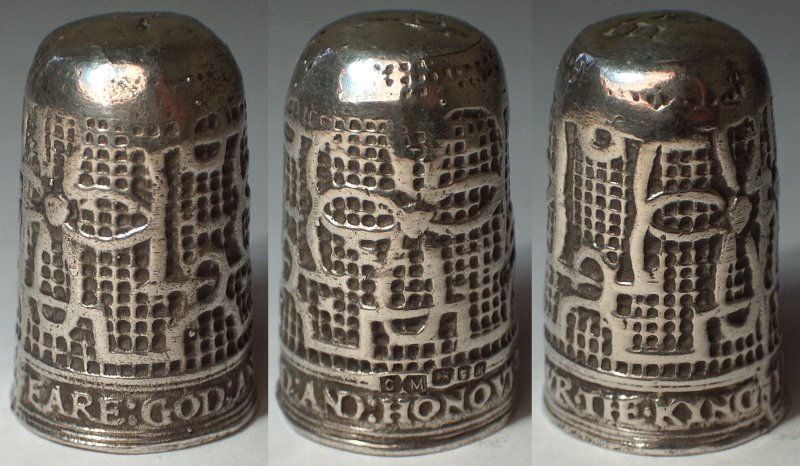
17th Century Silver Motto Thimble: FEARE GOD AND HONOR THE KING
17th century silver motto or virtue thimble. About this design Charterhouse Mint wrote: "17th Century: Inscribed FEARE GOD AND HONOR THE KING: it bears geometric designs of flowers within a boundary reminiscent of the formal box hedged gardens so characteristic of the great English country houses of the day."
◊
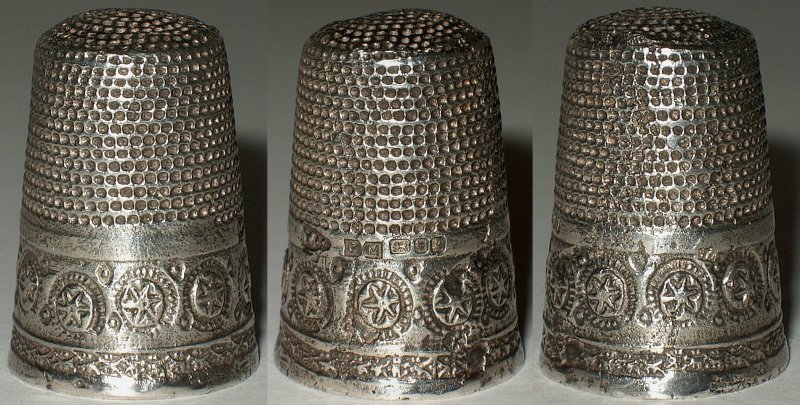
Nuremberg Type, Symbolic Border
Nuremberg type III thimble. The original would have been made of bronze or brass. Hand knurled top and decorative, symbolic border. About this thimble Charterhouse Mint wrote: "17th Century: This tall thimble bears the maker's mark of a little bird standing on a pedestal. As well as stars and planets is a pattern, incomprehensible to our century, but once an important part of European astrology."
◊
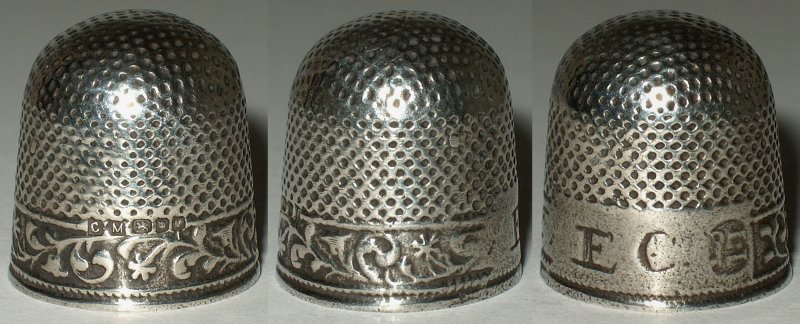
Small 18th Century Dome Shaped Thimble
Small dome shaped silver thimble typical of the 18th century, it has a floral border and cartouche for the owner's initials. To the right of the initials there is a maker's mark. About this thimble Charterhouse Mint wrote: "18th Century: Elegant and subtle, this beautifully decorated thimble could have been inspired by the great dome of Si. Paul's Cathedral. The owner's initials, EC, are incorporated on a panel containing beautiful floral relief.
◊
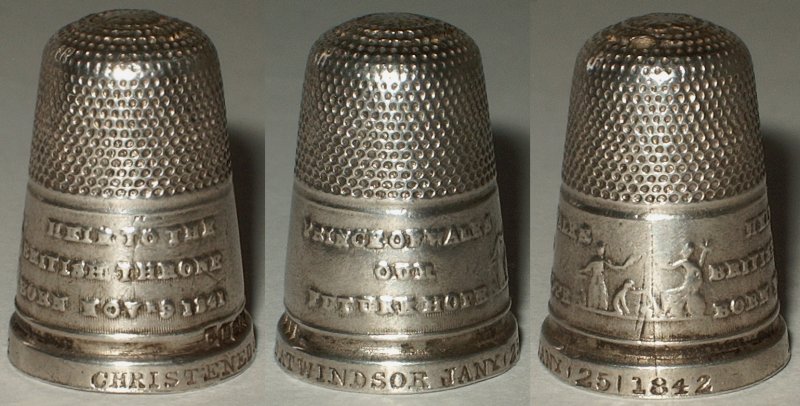
1842 Christening of Prince of Wales Silver Thimble
This thimble commemorates the christening at Windsor in 1842 of Queen Victoria's first son and heir, Prince Albert. In the border it has the lettering: 'HEIR TO THE BRITISH THRONE, BORN NOVR 9 1841' and 'PRINCE OF WALES OUR FUTURE HOPE'. The lettering around the rim reads: 'CHRISTENED AT WINDSOR CASTLE JANY 25 1842'. About this design Charterhouse Mint wrote: "In itself an important document of Royal history. This delicate thimble commemorates the christening of the Prince of Wales in 1842 and is a rare memento of the pomp and splendour of Victorian England."
◊

1841 Birth of Prince of Wales
Silver Thimble
This thimble commemorates the birth in 1841 of Queen Victoria's first son and heir, Prince Albert. It has the Prince of Wales feathers and motto 'ICH DIEN (I serve) and two cornucopias. About this design Charterhouse Mint wrote: "The Prince of Wales Feathers are the main decorative feature of this fine thimble commemorating the birth of the Prince of Wales in 1841. Inscribed 'ICH DIEN', the prince did not 'serve' until he was crowned King Edward VII in 1901."
◊
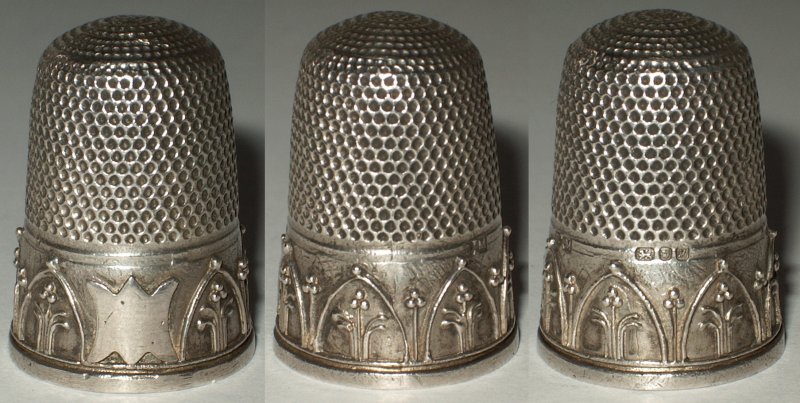
Silver Copy of a 19th Century Gold Thimble
About this silver copy of a Victorian gold thimble design Charterhouse Mint wrote: "One of the very few thimbles made in 18ct gold in the 19th century, the decoration is delicate yet vibrant. A perfect alliance of manufacturing skills and subtle design. A special feature is the 6-pointed star on which your engraver can put your monogram."
◊